Black Dub, Crosby Ravensworth - Coast to Coast
More Articles in the Haweswater to Orton subsection
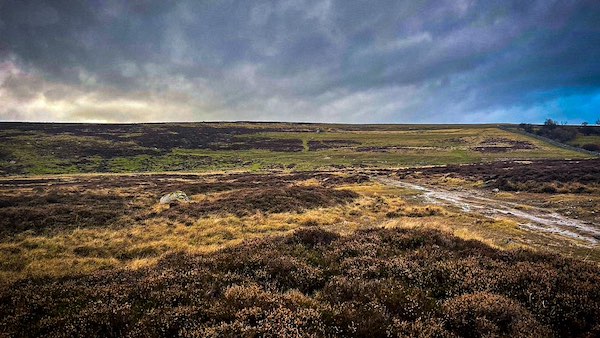
Coalpit Hill, above Black Dub and Lyvennet Beck
Black Dub Spring, Crosby Ravensworth Fell
Black Dub is the upland spring that gives rise to Lyvennet Beck, a modest flow that gathers strength eastward to become the River Lyvennet at King’s Meaburn before joining the River Eden near Temple Sowerby. The source lies high on Crosby Ravensworth Fell, just south-east of Coalpit Hill and close to the line of the Wicker Street Roman road. A little beyond the spring, the Coast to Coast path crosses Lyvennet Beck beside the great Lyvennet Glacial Erratic — one of the most striking boulders on the eastern fells.
A small stone monument marks the spring, often associated with King Charles II, while the nearby King’s Well lies about half a mile further east. Together they form one of the quieter historical corners of the Coast to Coast, where Roman routes, royal legend, and glacial geology converge on open limestone moor.
Black Dub Spring Charles II Monument
Black Dub is the small upland spring traditionally regarded as the source of the River Lyvennet, rising quietly on Crosby Ravensworth Fell. Beside it stands the Charles II Monument, a Grade II listed pillar erected in 1861 by local benefactor Thomas Bland to commemorate the king’s reputed visit in 1651. According to local tradition, Charles II paused here to drink from the spring while fleeing north after the Battle of Worcester, linking this remote fellside source with one of the most dramatic episodes in English history.
📜 Insight – History
Charles II
Oliver Cromwell, England’s Lord Protector, rejected his claim, and the royalist army was defeated later that year at the Battle of Worcester. Charles fled into exile, spending nine years moving between France, the Spanish Netherlands and the Holy Roman Empire. Only after Cromwell’s death did the monarchy return, and in 1660 Charles was restored to the throne in what became known as the Restoration.
The Merry Monarch
Charles acknowledged numerous illegitimate children by several mistresses, including Lucy Walter, Barbara Villiers, Nell Gwyn and Louise de Kérouaille. Unusually for an English monarch, he openly granted many of them noble titles and royal favour. This mixture of political resilience, personal indulgence and public charm shaped his enduring reputation — a king both controversial and compelling, whose legend lingers even in remote places like Black Dub.
Black Dub Monument South Face Inscription
The south face of the Charles II Monument carries the weathered inscription that ties the structure directly to Black Dub and the source of the River Lyvennet. It records the tradition that Charles II paused here on 8 August 1651 while marching south from Scotland, drinking from the spring and rallying his forces before the events that would culminate at Worcester. Three bas-reliefs decorate the remaining sides — a profile bust of the king, a crown symbolising the throne he sought to reclaim, and a lion — while the inscribed face is left plain, its softened lettering exposed to the fell weather.
Black Dub Lyvennet Headwaters
Reaching Black Dub involves leaving the main Coast to Coast line near the ford of Lyvennet Beck and striking out across the open limestone fell. The path is faint and often boggy underfoot, and although it does not appear on most Ordnance Survey maps, a trodden line can usually be followed along the beck’s north bank. This subtle approach reflects the quiet nature of the Lyvennet headwaters, where the landscape opens into wide, undulating moor with only the faintest signs of passage.
Lyvennet Beck Below Black Dub
Lyvennet Beck issues from Black Dub and threads quietly eastward across Crosby Ravensworth Fell, soon crossing the line of the Coast to Coast path. Near the ford, a faint trod follows the beck’s north bank back towards its source, offering the most direct approach to the spring. In these upper reaches the watercourse is narrow and easily overlooked, but it marks the beginning of a Cumbrian river that will gather strength through the Eden valley beyond.
Lyvennet Beck Crosby Ravensworth
Here at Crosby Ravensworth the young Lyvennet Beck is still little more than an upland stream, gathering volume as it leaves the fell behind. Downstream it strengthens through pasture and limestone country before becoming the River Lyvennet at King’s Meaburn, eventually joining the River Eden near Temple Sowerby. From its quiet beginnings at Black Dub, this modest beck grows steadily into one of the lesser-known but characterful tributaries of the Eden Valley.
Hiking the Coast to Coast trail guide
Hiking the Coast to Coast is a digitally enhanced eBook designed to accompany you on your journey along the Coast to Coast path. Available on Apple Books for iPhone, iPad and Mac, the guide includes:
• Mapping with interactive features
• Step-by-step route directions
• Hundreds of colour photographs
• Route conditions in different weather
• Historical and cultural points of interest
Whether you’re planning your trip or already on the trail, it’s a practical and beautifully illustrated resource to carry with you.