St Bees Lighthouse, Coast to Coast
More Articles in the St Bees to Ennerdale Bridge subsection
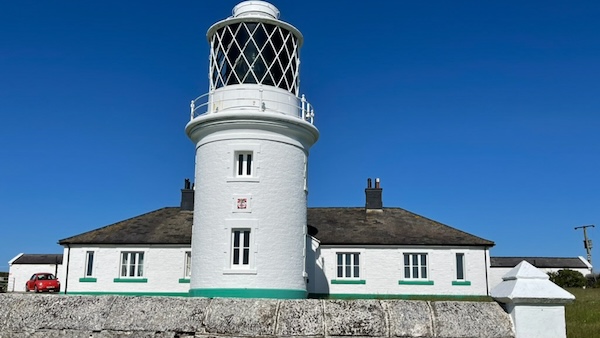
St Bees Lighthouse on North Head
St Bees Lighthouse, North Head, Coast to Coast
St Bees Lighthouse stands on the North Head bluff of the St Bees headland, positioned just below Hannah Moor on a grassy plateau overlooking the Irish Sea. It lies around 3 miles north of the Coast to Coast starting point at South Head, where the path meets the sea. The lighthouse also sits on the Cumbria Coastal Way, which shares this dramatic stretch of clifftop scenery.
North and South Head are divided by the secluded Fleswick Bay, where a steep flight of steps descends from the clifftop to the stony shore. The lighthouse itself is set about 150 metres inland, within a walled compound flanked by rough pasture grazed by cattle.
Perched directly opposite, right on the cliff edge, is the old foghorn station — decommissioned now, but still striking — standing over 100 metres above the sea.
St Bees Lighthouse on North Head
Standing brilliant white against the rough grassland of North Head, St Bees Lighthouse occupies one of the most exposed positions on the Cumbrian coast. Although set well back from the cliff edge, the ground beneath it rises to 102 metres above the Irish Sea, giving its light a commanding sweep across the water. On a clear day the horizon seems almost limitless; in darkness, its beam reaches up to 18 nautical miles out to sea. The present lighthouse was automated in 1987, but its white tower and distinctive green detailing remain an unmistakable landmark for walkers and mariners alike.
St Bees Foghorn Station
The St Bees foghorn station was decommissioned in 1987, but its sturdy frame and array of sea-facing speakers remain as a silent sentinel on the edge of North Head. Positioned high above the Irish Sea for maximum reach, it once sent deep, rhythmic warnings through thick coastal fog, guiding ships when the lighthouse beam could no longer be seen. Today the speakers are silent, exposed only to wind and salt spray — a striking reminder of the days when, if the light disappeared, sound became the mariner’s guide.
⚓ Insight - Maritime
From Coal Fire to Modern Beacon
The first lighthouse on St Bees Head was built in 1718 by Thomas Lutwige, at a time when keeping ships away from this exposed stretch of the Cumbrian coast depended upon little more than a fire burning in the darkness. Its light came from a coal-fired brazier — simple by modern standards and vulnerable to wind, weather and human neglect.
Disaster came in 1822, when fire destroyed the lighthouse. Its replacement represented a considerable technological advance, using multiple oil burners to produce a brighter and more dependable light. Yet the development of St Bees Lighthouse did not end there.
The present lighthouse dates from 1866. Its 17-metre masonry tower stands on North Head, where the land itself rises to about 102 metres above sea level. The height of the headland allows a relatively modest tower to command an extraordinary sweep of the Irish Sea.
The final transformation came with automation in 1987. The lighthouse no longer needed resident keepers, while the neighbouring foghorn fell silent. More than two and a half centuries after a coal fire first warned sailors away from St Bees Head, the same purpose remained — a light in the darkness marking the edge of the Cumbrian coast.
At a Glance
First lighthouse: 1718
Original light: Coal-fired brazier
Destroyed by fire: 1822
Present lighthouse: 1866
Tower height: 17 metres
Elevation: About 102 metres above sea level
Automated: 1987
Light range: Up to 18 nautical miles
St Bees Lighthouse and the Isle of Man
From Tarnflatt Hall on Hannah Moor, the view unfolds across green farmland to St Bees Lighthouse, with the Irish Sea glinting beyond and the distant Isle of Man rising on the horizon. Though some 46 miles away, Snaefell, the island’s highest peak at 621 metres, can be clearly visible on fine days. Across so much open water, the island can appear surprisingly close — a striking reminder of the wider landscape beyond the Cumbrian coast.
St Bees Lighthouse Farmstead
Just south of the lighthouse compound, a large barn and adjoining outbuildings form part of the North Head farmstead. The buildings sit naturally among the surrounding grazing pastures, where cattle often roam between the lighthouse and the Coast to Coast path. Seen from the south-west, lighthouse and farm create an unusual meeting of two landscapes — one shaped by the sea, the other by generations of farming.
Take the Coast to Coast Guide With You
Available on Apple Books — £12.99
Hiking the Coast to Coast combines step-by-step route directions, interactive mapping, hundreds of original photographs and information about the landscapes, history and places encountered along the route.
© 2026 Roy McKee · Coast to Coast
Contact - Privacy. - Terms


