Vale of Mowbray, Coast to Coast
More Articles in the Danby Wiske to Swainby subsection

Looking over the Vale of Mowbray to Roseberry Topping
Mowbray and Hay Making, Coast to Coast
The Vale of Mowbray is a low-lying flat plain of arable farmland between Richmond and the Yorkshire Dales to the west, and Ingleby Arncliffe at the foot of the Cleveland Hills or North York Moor, to the east. More precisely, it stretches from north to south from just north of Richmond to just beyond Thirsk. These two towns lay in the approximate west-east heart of the Vale. The North York Moors assumes the eastern border and the Yorkshire Dales and the Pennines, the western border. The continuation of the central plain leading south from the Vale of Mowbray is the Vale of York. To the north east of the Vale another large expanse of sea level farmland stretches towards the North Sea, bordered on the south by the north facing North York Moors. This area is known as the Tees Lowlands.
Some common characteristics of property in Mowbray are the long meandering rivers such as the Rivers Wiske and Swale, and the lush and eternal cropland and the small scattered woodlands.
The high summer hay making is a particular delight to observe. Summertime Coast to Coast walkers cannot help but see it as they spend on average two days walking in the Vale
Tees Lowlands Carlton Bank
From Carlton Moor on the north west margin of the North York Moors there are stunning views over the Vale of Mowbray and the Tees Lowlands Immediately below Carlton Bank are the Deeply hued broadleaves of Busby Wood, with Carlton in Cleveland a little beyond. On the horizon is Middlesbrough.
Tees Lowlands Faceby Bank
Looking over the heather clad Faceby Bank the perpetually present profile of Whorl Hill dominates the Valley. In the north west segment of the North York Moors Whorl Hill appears in every view of the Tees Lowlands and is a most useful navigational aid.
Coast to Coast Bolton-on-Swale
Bolton-on-Swale is in the west part of Mowbray. Here, as in most of the Vale, the ground is flat and conducive to agriculture. The Coast to Coast path passes through Bolton-on Swale, where the path snakes its way alongside the Bolton Beck.
Hodber Hill Plantation
The Coast to Coast path passes through Hodber Hill Plantation en route to Whitwell. The path cuts through the heart of the wood, sensitive to the dense undergrowth and deep slime pools each side.
Plumtree Moor Plantation
At Whitwell Moor a view south to Plumtree Moor Plantation gives perspective to the neverending farmland crops stretching in every direction as far as you can see. The fields are only interrupted by small belts of trees.
Toft Hill Ellerton
From Toft Hill near to Kiplin there is a picturesque view across the agricultural crops to Ellerton-on-Swale. All around, in the Vale of Mowbray, can be seen the produce of a rich and productive valley.
Harlsey Grove Coast to Coast
Harlsey Grove is a moated farm on the Coast to Coast path between Danby Wiske and Ingleby, close to Wray House and the Stockton to Northallerton railway.
Bean Crops Longlands
A huge field of Bean crops blooming into maturity at Longlands Farm. Longlands lies at the eastern extremity of the Vale of Mowbray, not far from the foot of the Cleveland Hills, less than a mile from Ingleby Arncliffe.
Moor House Mowbray
Modern mechanized hay production today is usually performed by a number of machines. While small operations use a tractor to pull various implements for mowing and raking, larger operations use specialized machines such as a mower or a swather, which are designed to cut the hay and arrange it into a windrow in one step.
Haymaking Moor House
Balers are usually pulled by a tractor, with larger balers requiring more powerful tractors. Mobile balers, machines which gather and bale hay in one process, were first developed around 1940. The first balers produced rectangular bales small enough for a person to lift, usually between 70 and 100 pounds (32 and 45 kg) each.
Conditioning the Haylage
Conditioning of hay has become popular. The basic idea is that it decreases drying time, particularly in humid climates or if rain interferes with haying. Usually, a salt solution is sprayed over the top of the hay (generally alfalfa) that helps to dry the hay. Conditioning can also refer to the rollers inside a swather that crimps the alfalfa to help squeeze out the moisture.
Coast to Coast Trail Guide
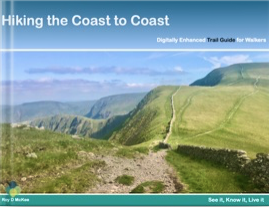
Hiking the Coast to Coast
"Hiking the Coast to Coast" is a digitally enhanced eBook available from Apple Books for all people who have either a Mac, an iPhone or an iPad, and is designed to accompany you on your walk of the Coast to Coast path. The trail guide contains Ordnance Survey maps and other advanced mapping features, step by step directions, hundreds of colour photographs, details of the route, its conditions in different weather and research snippets relating to places of interest along the way.