Little Asby, Crosby Garrett - Coast to Coast
More Articles in the Orton to Kirkby Stephen subsection

Attaining Litle Asby from a path across fields from the Sunbiggin road
Little Asby, Crosby Garrett - Coast to Coast
Little Asby is a peaceful limestone village on the northern fringe of the Orton Fells, set beneath the broad pavement of Little Asby Scar. To the east, the secluded Potts Valley curves around the foot of the Scar, separating it from Crosby Garrett Fell. A public footpath leaves the north-east corner of the village and follows the valley, providing one of the principal walking routes onto Crosby Garrett Fell and the surrounding limestone uplands.
The Old Chapel Little Asby
Standing prominently on Little Asby’s single village street, the Old Chapel seems entirely at home among the surrounding stone cottages and farmhouses. Built in 1889 as a Congregational chapel, its simple façade reflects the restrained character of this small limestone village. Now converted into a private home, it survives as a quiet reminder of village worship, while beyond Little Asby the ruined foundations of medieval St Leonard’s Church reach still further back into the community’s past.
Dwellings in Little Asby
Along Little Asby’s single street, cottages and farmhouses gather in an appealing mixture of shapes and styles, united by the local stone from which they were built. Near the Sunbiggin Road junction, cattle often graze the small village green, bringing the surrounding farmland almost into the centre of the settlement. There is an unhurried quality here — stone walls, gardens and grazing animals forming a village that seems to merge naturally into the limestone countryside around it.
Burtree
On the western edge of Little Asby, Burtree is almost swallowed by the small copse surrounding it, its buildings glimpsed through a screen of mature trees. The name comes from the Old English for “elder tree”, an appealing survival from a time when a conspicuous tree could help define a place. After the open limestone country around the village, Burtree feels unusually secluded — a little pocket of shelter and shade tucked into the edge of the fell.
Asket Dub
Beside the moorland road west of Little Asby, Asket Dub is slowly disappearing into its own vegetation. What was once a small area of open water has gradually filled with reeds, grasses and accumulated organic matter as natural pond succession takes its course. Seen against the open limestone country, it is a landscape quietly changing before the eye — water becoming marsh, and marsh ultimately giving way to dry ground.
Middle Busk Treefold
Beside the limestone crag of Middle Busk, the circular stone treefold known as Circle of Land’s Bones encloses an oak and a rowan, planted as part of the Legacy Tree project marking the 2017 Tree Charter. Against the open, largely treeless limestone landscape, the little enclosure has an almost symbolic presence — stone protecting new life, while the rugged crag rises immediately behind it.
Hill North of Little Asby
Immediately north of the village, this low limestone hill rises gently above the approach road, its rounded summit crowned by a small copse of trees. Against the largely open, treeless country around Little Asby, the dark cluster on the skyline makes a surprisingly distinctive landmark. For walkers approaching across the moorland, it provides a quiet signal that the scattered limestone landscape is giving way once again to settlement.
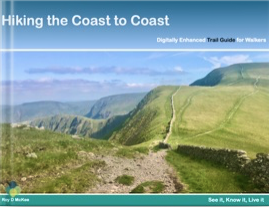
Hiking the Coast to Coast trail guide
Hiking the Coast to Coast is a digitally enhanced eBook designed to accompany you on your journey along the Coast to Coast path. Available on Apple Books for iPhone, iPad and Mac, the guide includes:
• Mapping with interactive features
• Step-by-step route directions
• Hundreds of colour photographs
• Route conditions in different weather
• Historical and cultural points of interest
Whether you’re planning your trip or already on the trail, it’s a practical and beautifully illustrated resource to carry with you.