Danby Church and Moat, Coast to Coast
More Articles in the Richmond to Danby Wiske subsection

Danby Wiske Church, Danby Wiske
Danby Church, Danby Wiske, Coast to Coast
Danby Wiske Church is located in Mounstrall Lane, on the south side of Danby Wiske. Immediately abutting the church on its south side is the former Danby Rectory, which is a moated site. The Church has a Grade 1 Listing with Historic England. The Moated Site is also listed as a Scheduled Monument with Historic England but does not have a grading. Most moated sites date from 1250 to 1350.
The church is undedicated and is known simply as Danby Wiske church. This is due to the church records being destroyed when the Scots raided the North in the 12th century. The Domesday Book refers to Danby Wiske as Danebi. The River Wiske flows around the east side of the Church and a little beyond that are the remains of Lazenby Medieval Village.
Danby Wiske Church
The church in Danby Wiske is undedicated, meaning it has no name, and is known as Danby Wiske Parish Church. Like so many older buildings in Danby Wiske the church is a Grade II Listed Building. The building incorporates the original early Norman church.
Danby Wiske Church
Danby Wiske Church started out as a 12th century Norman church, although the chancel and north aisle were added in the 14th century, and the belfry in the15th. The main entry door to the south has a Norman Tympanum. Within the church is the effigy of Matilda, the widow of Brian FitzAlan of Bedale circa 1340.
Norman Tympanum
A tympanum is a semi-circular or triangular decorative wall surface over an entrance, that has a lintel and arch usually containing a sculpture. This tyjpanum, above the church entrance door is early Norman, about 1090 to 1120. The sandstone carving is said to represent the weighing of the soul and is meant to remind the congregation as they enter the church, that the Day of Judgment is inevitable.
Matilda
Located in the church's chancel is a life-size effigy of Matilda, the second wife of and the widow of Brian FitzAlan of Bedale. He was the Lord of the Manor of Bedale in North Yorkshire and has his own Coat of Arms. His title name is 1st Baron FitzAlan of Bedale. He died in 1306. This stone effigy was once the cover of Matilda's tomb.
Norman Font
The font in Danby Wiske church is early Norman, and has an above average size bowl. The Norman period is 1066 to 1154. The Normans were inhabitants of Normandy and arose from the interweaving of the Norse Viking settlers and Indiginous West Franks and Gailo-romans.
Belfry Danby Wiske Church
The belfry has a peel of 3 bells. There are 2 slit windows and 2 light 15th century belfry windows. There is an embattled parapet. The tower is made of ashlar stone with offset diagonal butresses. Ashlar is finely dressed, squared stone, usually rectangular cuboid.
Rectory Moat
The Danby Wiske moated site consists of an irregular ellipse enclosing an area of about 2 hectares. Another, small rectangular moated site is found to the north east, less than a half hectare away. There is an earthwork enclosure at the north of the outer moat. On the east the moat now exists as a shallow ditch. At the west there is a double earthwork including a prominent outer bank with an internal moat. This part of the Moat is thought to be a former fish pond, forming part of the moat.
Rectory Moat
The River Wiske flows to the east of the moated site, and in the north east corner there is the remains of a connecting channel to the river. The remains of buildings survive beneath the ground. The 3 domiciles within the moated site are not scheduled. these are The Rectory, Glebe House and the Moat House.
Rectory Moat
The Rectory Moat is an ungraded Scheduled Monument and includes the earthwork and buried remains of the medieval site. It is elliptical in outline and encloses an area of approximately 2 hectares.
Coast to Coast Trail Guide
Hiking the Coast to Coast
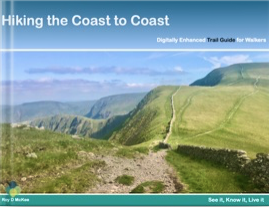
"Hiking the Coast to Coast" is a digitally enhanced eBook available from Apple Books for all people who have either a Mac, an iPhone or an iPad, and is designed to accompany you on your walk of the Coast to Coast path. The trail guide contains Ordnance Survey maps and other advanced mapping features, step by step directions, hundreds of colour photographs, details of the route, its conditions in different weather and research snippets relating to places of interest along the way.