Margery Bradley Stone, Coast to Coast
Historical and Educational Articles for Lion Inn to Grosmont
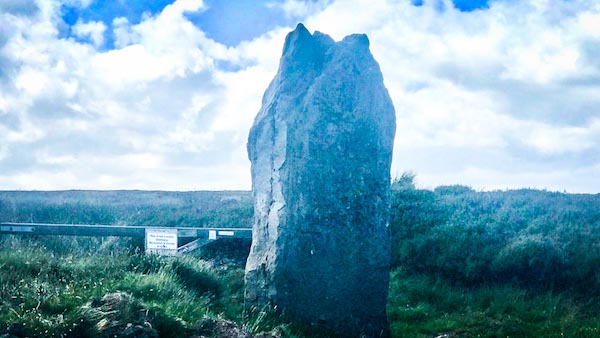
The Margery Bradley Stone viewed from the road, east of the Stone. This image was taken in 2018 when the path to Flat Howe, at the rear, was closed to the public. It has now been re-opened.
Margery Bradley Stone, Blakey, Coast to Coast
Associated with the Jenny Bradley Cross near to Bloworth Crossing on Stockdale Moor, is the Margery Bradley Wayside and Boundary Stone, a Grade II Scheduled Monument. This Stone is positioned at the side of Blakey Road opposite to Rosedale Head. The Margery Stone is only 200m east north east of Flat Howe. The Lion Inn is less than a mile south along the Blakey Road.
The Margery Bradley Stone has been located in its current position since medieval times, but it is thought that it originated during the Bronze Age and may be associated with the nearby Flat Howe Round Barrow.
The Margery Bradley Stone was once named "Breadless" and was a place where beggars gathered to seek alms. The same goes for the Jenny Bradley Cross, often referred to as the sister stone to the Margery Bradley Stone for the same reason.
The Stone was regarded as an important marker when the Beaker Folk from mid and eastern Europe settled in the area about 4,500 years ago, i.e. during the Bronze Age. They derived their name from their unique bell-shaped pottery, mostly used as drinking vessels and having an elegant flared lip. They also introduced the custom of burying their dead in raised earthern burial mounds.
Margery Bradley Wayside Stone
The Margery Bradley Stone is also known as the Margery Stone. As well as being a Wayside Stone it has doubled up as a Boundary Stone for the Thomas Duncombe estate since the 18th century. Thomas Duncombe was the owner of the Honour of Helmsley. The Stone stands at the meeting point of three parishes, namely Farndale East, Rosedale West Side and Westerdale.
Margery Stone
The Margery Bradley Stone stands at the side of the Blakey Road. Its west facing side, i.e. the side facing away from the road contains a large, bold engraving of the initials T.D., thus confirming its double role of marking a Thomas Duncombe estate boundary. The Stone is thought to have served as a waymarker as long ago as the Bronze Age (2400-1500 BC).
Beaker Folk Beakers
Sample "inverted bell" beakers of the Beaker Folk dating to the Bronze Age, on display at the British Museum. The Beaker Folk arrived in England from the Continent about 2700-2500 BC, peacefully adapting to the existing Neolithic Culture. They introduced new burial practices, replacing long barrows with Round Barrows. Beakers like this sample were often buried with their dead.
Coast to Coast Trail Guide
Hiking the Coast to Coast
"Hiking the Coast to Coast" is a digitally enhanced eBook available from Apple Books for all people who have either a Mac, an iPhone or an iPad, and is designed to accompany you on your walk of the Coast to Coast path. The trail guide contains Ordnance Survey maps and other advanced mapping features, step by step directions, hundreds of colour photographs, details of the route, its conditions in different weather and research snippets relating to places of interest along the way.